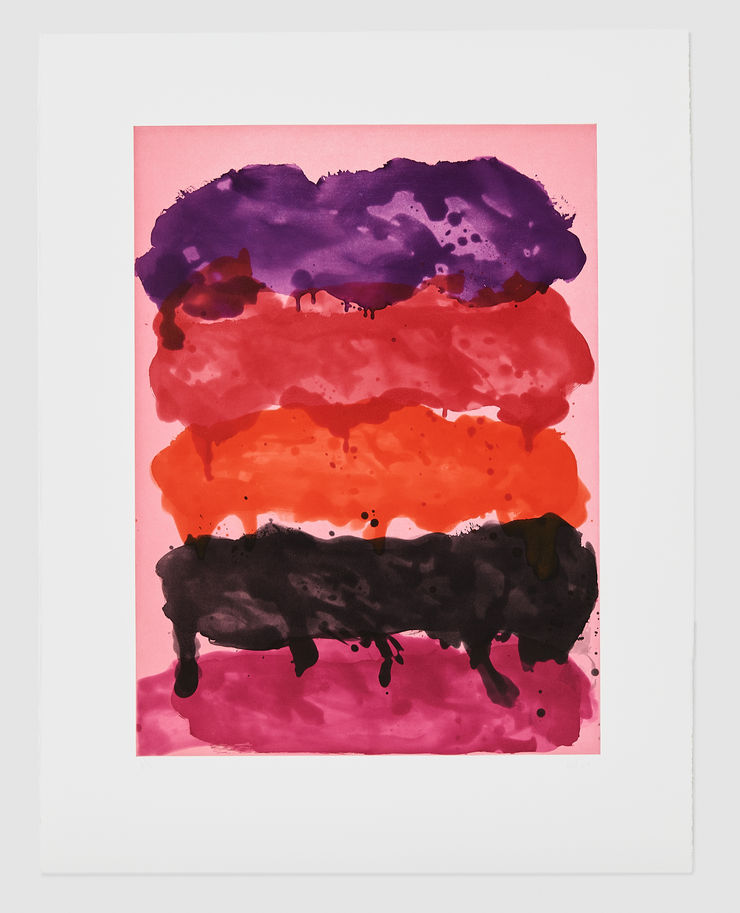
Sol LeWitt
Emblemata Portfolio, 2000
15 Monotypes
11 1/4 x 22 in
28.6 x 55.9 cm
28.6 x 55.9 cm
Edition of 70 plus 20 AP
Copyright Sol Lewitt
Sold
Further images
-
(View a larger image of thumbnail 1
)

-
(View a larger image of thumbnail 2
)

-
(View a larger image of thumbnail 3
)

-
(View a larger image of thumbnail 4
)

-
(View a larger image of thumbnail 5
)

-
(View a larger image of thumbnail 6
)

-
(View a larger image of thumbnail 7
)

-
(View a larger image of thumbnail 8
)

-
(View a larger image of thumbnail 9
)

-
(View a larger image of thumbnail 10
)

-
(View a larger image of thumbnail 11
)

-
(View a larger image of thumbnail 12
)

-
(View a larger image of thumbnail 13
)

-
(View a larger image of thumbnail 14
)

-
(View a larger image of thumbnail 15
)

-
(View a larger image of thumbnail 16
)

-
(View a larger image of thumbnail 17
)

-
(View a larger image of thumbnail 18
)

-
(View a larger image of thumbnail 19
)

-
(View a larger image of thumbnail 20
)

-
(View a larger image of thumbnail 21
)

-
(View a larger image of thumbnail 22
)

-
(View a larger image of thumbnail 23
)

-
(View a larger image of thumbnail 24
)

-
(View a larger image of thumbnail 25
)

-
(View a larger image of thumbnail 26
)

-
(View a larger image of thumbnail 27
)

In 2000, Sol LeWitt accepted the invitation from the Italian print publisher Edizioni Essegi Ravenna to create an artist’s book as part of its 'Emblemata' collection. Conceived as a twentieth-...
In 2000, Sol LeWitt accepted the invitation from the Italian print publisher Edizioni Essegi Ravenna to create an artist’s book as part of its "Emblemata" collection. Conceived as a twentieth- and twenty-first-century reimagining of “emblem books” – a tradition five centuries old, the series provided a framework for artists to translate their visual language into book form. For this project, LeWitt produced a volume of fifteen monotypes in a studio in Urbino.
Each print in "Emblemata" was created by rolling oil-based color onto a plate, then working back into the surface with a brush before printing. This process results in prints that are structurally consistent but materially variable—each impression being a distinct realization of a single underlying idea. As such, the portfolio resists the notion of the print as a fixed, repeatable image.
This approach closely parallels LeWitt’s wall drawings—among the most influential works of Conceptual Art—in which the artist provides a set of instructions while the physical execution is carried out by others. In both cases, the work exists first as a system: a defined structure that allows for variation in its realization. The result is not a single, authoritative object, but a field of possible outcomes governed by a shared logic.
The historical precedent for this project lies in the emblem book tradition first formalized with the publication of "Emblemata" in Augsburg, Bavaria, in 1531. These emblem books combined image, motto, and explanatory text to communicate moral or philosophical ideas, functioning as a hybrid of visual and literary instruction. Popular through the eighteenth century, these books served as an early model for the integration of text and image.
Edizioni Essegi Ravenna’s contemporary "Emblemata" series reconsiders the emblem book tradition by inviting artists to construct their own “ideal” volumes, “transposing their sign, the ‘emblematic’ code of their poetic vision into a book through the use of materials, printing technique, and manual skills they consider adequate to this purpose.” The series often incorporates text—either by the artist or a collaborator—as part of this exchange, though its broader aim is “the passing on of knowledge, as a direct form of communication between the artist and reader, which allows the latter to ‘see,’ not just look.”
LeWitt’s contribution is consistent with his broader artistic philosophy. In his 1967 essay “Paragraphs on Conceptual Art,” he wrote: “In conceptual art, the idea or concept is the most important aspect of the work… all of the planning and decisions are made beforehand and the execution is a perfunctory affair.” The work, in other words, is generated through a system established in advance.
As LeWitt further explains, such systems may yield either a finite number of variations or imply an effectively infinite set of outcomes. In each case, the artist defines the parameters that govern the work’s realization, reducing subjective decision-making in favor of clarity and logic. This deliberate removal of arbitrariness is central to his practice and allows the idea itself to function as the primary creative force. As he put it succinctly, “The idea becomes a machine that makes the art,” offering a blueprint for a generation of conceptual artists. Over the course of his career, LeWitt played a pivotal role in shaping both Minimalism and Conceptual Art, extending the possibilities of abstraction by shifting emphasis from composition and gesture to structure and process. His work reframed the artwork not as a singular object, but as the manifestation of an idea—one that could be repeated, adapted, or reinterpreted without losing its essential identity.
The "Emblemata" portfolio embodies this principle with discrete clarity. While governed by a conceptual framework, the prints retain a strong physical presence: the density of ink, the movement of the brush, and the subtle differences between impressions remain visible. This tension between system and variation—between control and contingency—is what gives the work its enduring vitality.
Works by LeWitt are held in major public collections worldwide, including the Art Institute of Chicago, the Centre Pompidou, the Dia Art Foundation, the Guggenheim Museum, the Museum of Modern Art, the National Galleries of Scotland, the National Gallery of Art, Tate, the Walker Art Center, and the Whitney Museum of American Art, among many others.
Each print in "Emblemata" was created by rolling oil-based color onto a plate, then working back into the surface with a brush before printing. This process results in prints that are structurally consistent but materially variable—each impression being a distinct realization of a single underlying idea. As such, the portfolio resists the notion of the print as a fixed, repeatable image.
This approach closely parallels LeWitt’s wall drawings—among the most influential works of Conceptual Art—in which the artist provides a set of instructions while the physical execution is carried out by others. In both cases, the work exists first as a system: a defined structure that allows for variation in its realization. The result is not a single, authoritative object, but a field of possible outcomes governed by a shared logic.
The historical precedent for this project lies in the emblem book tradition first formalized with the publication of "Emblemata" in Augsburg, Bavaria, in 1531. These emblem books combined image, motto, and explanatory text to communicate moral or philosophical ideas, functioning as a hybrid of visual and literary instruction. Popular through the eighteenth century, these books served as an early model for the integration of text and image.
Edizioni Essegi Ravenna’s contemporary "Emblemata" series reconsiders the emblem book tradition by inviting artists to construct their own “ideal” volumes, “transposing their sign, the ‘emblematic’ code of their poetic vision into a book through the use of materials, printing technique, and manual skills they consider adequate to this purpose.” The series often incorporates text—either by the artist or a collaborator—as part of this exchange, though its broader aim is “the passing on of knowledge, as a direct form of communication between the artist and reader, which allows the latter to ‘see,’ not just look.”
LeWitt’s contribution is consistent with his broader artistic philosophy. In his 1967 essay “Paragraphs on Conceptual Art,” he wrote: “In conceptual art, the idea or concept is the most important aspect of the work… all of the planning and decisions are made beforehand and the execution is a perfunctory affair.” The work, in other words, is generated through a system established in advance.
As LeWitt further explains, such systems may yield either a finite number of variations or imply an effectively infinite set of outcomes. In each case, the artist defines the parameters that govern the work’s realization, reducing subjective decision-making in favor of clarity and logic. This deliberate removal of arbitrariness is central to his practice and allows the idea itself to function as the primary creative force. As he put it succinctly, “The idea becomes a machine that makes the art,” offering a blueprint for a generation of conceptual artists. Over the course of his career, LeWitt played a pivotal role in shaping both Minimalism and Conceptual Art, extending the possibilities of abstraction by shifting emphasis from composition and gesture to structure and process. His work reframed the artwork not as a singular object, but as the manifestation of an idea—one that could be repeated, adapted, or reinterpreted without losing its essential identity.
The "Emblemata" portfolio embodies this principle with discrete clarity. While governed by a conceptual framework, the prints retain a strong physical presence: the density of ink, the movement of the brush, and the subtle differences between impressions remain visible. This tension between system and variation—between control and contingency—is what gives the work its enduring vitality.
Works by LeWitt are held in major public collections worldwide, including the Art Institute of Chicago, the Centre Pompidou, the Dia Art Foundation, the Guggenheim Museum, the Museum of Modern Art, the National Galleries of Scotland, the National Gallery of Art, Tate, the Walker Art Center, and the Whitney Museum of American Art, among many others.
Related artworks
-
 Robert Storr, Celebesstraat, 2025
 -
Sol Lewitt, Curvy Bands Portfolio, 1996
-
Sol Lewitt, Parallel Curves (Red) , 2000
-
Mary Heilmann, Joaquin's Close Out, 2006
-
Mary Heilmann, Thief of Baghdad, 2007