Helen Frankenthaler
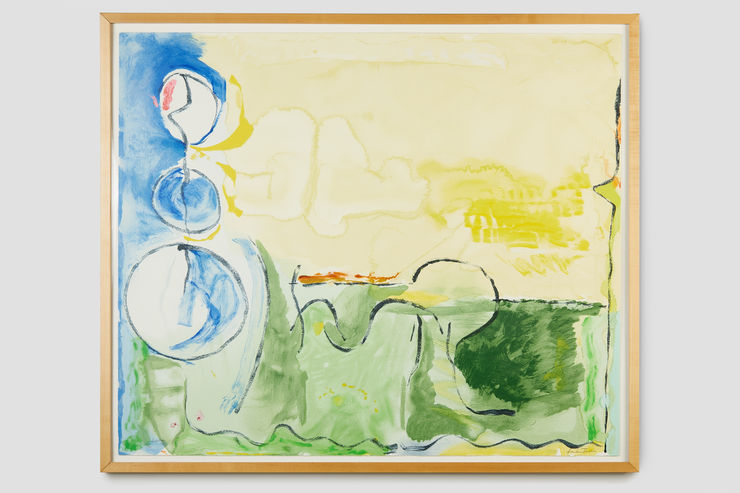
Plaza Real, 1987
Color etching and aquatint
Paper size: 28 3/8 x 35 in (72.1 x 88.9 cm)
Image size: 20 × 26½ in (50.8 x 67.31 cm)
Image size: 20 × 26½ in (50.8 x 67.31 cm)
#55/60
Copyright Helen Frankenthaler
Further images
Helen Frankenthaler's 'Plaza Real' (1987) is a superb example of the artist's mature printmaking practice, produced during a pivotal collaboration with Ediciones Polígrafa in Barcelona. Created at a point when...
Helen Frankenthaler's "Plaza Real" (1987) is a superb example of the artist's mature printmaking practice, produced during a pivotal collaboration with Ediciones Polígrafa in Barcelona. Created at a point when Frankenthaler was continuing to push the expressive possibilities of intaglio, the work exemplifies the same commitment to color, gesture, and technical experimentation that established her as one of the leading figures of postwar American abstraction. While celebrated for her pioneering role in the development of Color Field painting, Frankenthaler approached printmaking as an equally inventive medium, using it to explore chromatic space and complex printing techniques with remarkable sophistication.
In 1987, Frankenthaler traveled to Barcelona to work at Ediciones Polígrafa, S.A., owned then by Joan de Muga. During an intense ten-day residency, she generated the plates that would form several editions, including "Plaza Real." As with other workshop projects in her career, the initial burst of production was followed by months of refinement. De Muga made multiple trips to Frankenthaler's New York studio, where they reviewed proofs and adjusted color, plate states, and sequencing before the edition was approved in April 1988. The resulting print reflects this extended collaboration—what Frankenthaler described as a process of "changing and exchanging," developing a vocabulary, and then learning how to "spell the words."
Technically, "Plaza Real" is a soft-ground etching with aquatint, printed in seven colors from three copper plates. The luminous yellow ground was printed first, establishing a radiant chromatic field that dominates the composition. A second plate carries black, gray, blue, red, and orange passages, while a third plate prints white, activating negative space and clarifying edges. The principal black imagery was created by coating the copper plate with varnish and dissolving it with a turpentine-soaked rag, allowing Frankenthaler to manipulate the exposed copper with painterly immediacy. A dense black band along the lower edge, reinforced through aquatint, anchors the composition and introduces a structural counterpoint to the buoyant yellow expanse.
The title "Plaza Real" likely references the historic square, also known as Plaça Reial, just off La Rambla in Barcelona. The title underscores how Frankenthaler absorbed the ambience of the environment she was working in. With an economy of shapes and lines, the bold yellow ground, animated by three brightly colored dots as well as faint circles and swirls, captures the vibrancy and energy of the square. She often noted that the character of each workshop—the light in the press room, the rhythm of the city outside, and the personalities of the printers—shaped the work produced.
Frankenthaler's approach to the prints she produced at Polígrafa demonstrates that her commitment to experimentation remained central throughout her career. Rather than treating printmaking as a secondary or reproductive practice, she used intaglio as a site of invention, building plates, revising states, and refining color sequences through sustained proofing. "Plaza Real" stands as a compelling example of her late-1980s printmaking—technically complex, chromatically assertive, and fully aligned with the innovations that secured her place in the history of postwar abstraction.
Works by Helen Frankenthaler are held in major museum collections including the Museum of Modern Art in New York, the National Gallery of Art in Washington, D.C., and the Tate in London.
In 1987, Frankenthaler traveled to Barcelona to work at Ediciones Polígrafa, S.A., owned then by Joan de Muga. During an intense ten-day residency, she generated the plates that would form several editions, including "Plaza Real." As with other workshop projects in her career, the initial burst of production was followed by months of refinement. De Muga made multiple trips to Frankenthaler's New York studio, where they reviewed proofs and adjusted color, plate states, and sequencing before the edition was approved in April 1988. The resulting print reflects this extended collaboration—what Frankenthaler described as a process of "changing and exchanging," developing a vocabulary, and then learning how to "spell the words."
Technically, "Plaza Real" is a soft-ground etching with aquatint, printed in seven colors from three copper plates. The luminous yellow ground was printed first, establishing a radiant chromatic field that dominates the composition. A second plate carries black, gray, blue, red, and orange passages, while a third plate prints white, activating negative space and clarifying edges. The principal black imagery was created by coating the copper plate with varnish and dissolving it with a turpentine-soaked rag, allowing Frankenthaler to manipulate the exposed copper with painterly immediacy. A dense black band along the lower edge, reinforced through aquatint, anchors the composition and introduces a structural counterpoint to the buoyant yellow expanse.
The title "Plaza Real" likely references the historic square, also known as Plaça Reial, just off La Rambla in Barcelona. The title underscores how Frankenthaler absorbed the ambience of the environment she was working in. With an economy of shapes and lines, the bold yellow ground, animated by three brightly colored dots as well as faint circles and swirls, captures the vibrancy and energy of the square. She often noted that the character of each workshop—the light in the press room, the rhythm of the city outside, and the personalities of the printers—shaped the work produced.
Frankenthaler's approach to the prints she produced at Polígrafa demonstrates that her commitment to experimentation remained central throughout her career. Rather than treating printmaking as a secondary or reproductive practice, she used intaglio as a site of invention, building plates, revising states, and refining color sequences through sustained proofing. "Plaza Real" stands as a compelling example of her late-1980s printmaking—technically complex, chromatically assertive, and fully aligned with the innovations that secured her place in the history of postwar abstraction.
Works by Helen Frankenthaler are held in major museum collections including the Museum of Modern Art in New York, the National Gallery of Art in Washington, D.C., and the Tate in London.
Related artworks
-
 Helen Frankenthaler, Flotilla, 2006
 -
Helen Frankenthaler, Madame de Pompadour, 1985-1990
-
Helen Frankenthaler, Weeping Crabapple, 2009
-
Robert Motherwell, French Revolution Bicentennial Suite, 1988
-
Robert Motherwell, Primal Sign IV, 1980