Miriam Schapiro
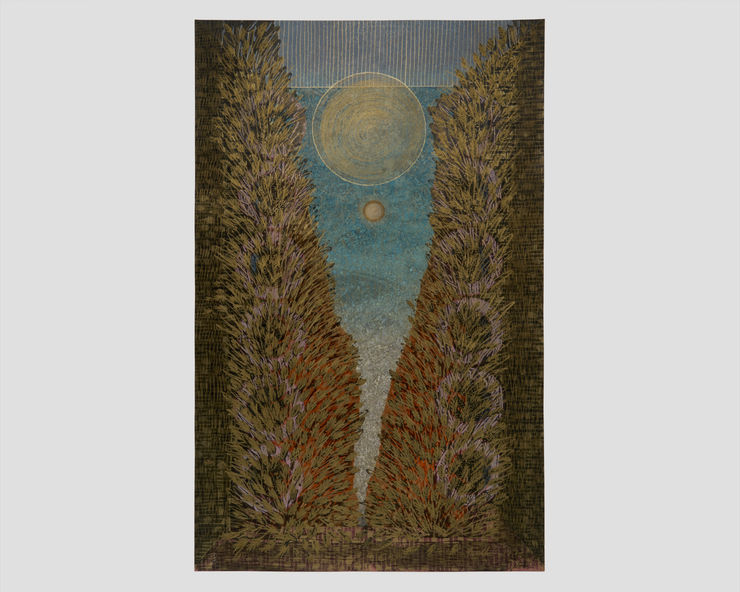
In the Heat of Winter, 1994
Screenprint in 11 colors with fabric and paper collage on Lenox rag paper
33 x 62
83.8 x 157.5
83.8 x 157.5
Edition #25/40
Copyright Miriam Schapiro
Further images
Measuring more than five feet across, 'In the Heat of Winter' (1994) is the largest—and arguably the most ambitious—print produced during Miriam Schapiro’s career. Its monumental fan brings together many...
Measuring more than five feet across, "In the Heat of Winter" (1994) is the largest—and arguably the most ambitious—print produced during Miriam Schapiro’s career. Its monumental fan brings together many of the concerns that defined Schapiro’s practice: the relationship between abstraction and decoration, her incorporation of textiles into fine art, and her sustained effort to reclaim materials and forms historically associated with women’s creative labor. Produced during the final decade of her career, the work occupies a distinctive position within the oeuvre of an artist who was both a pioneering figure in the Feminist Art movement and a founding member of the Pattern and Decoration movement.
The fan was one of the most important motifs in Schapiro’s work. During the 1970s, she began developing what she described as a "lexicon of forms" drawn from objects historically associated with femininity. By enlarging and "heroizing" these forms, Schapiro challenged the cultural hierarchies that had traditionally relegated them—and the forms of women’s labor associated with them—to the category of craft. The fan became an especially rich vehicle for this investigation, allowing Schapiro to combine associations of femininity, adornment, and domesticity with the formal possibilities of symmetry, pattern, and abstraction. In "In the Heat of Winter," the motif reaches its most ambitious realization in print.
Schapiro’s engagement with these questions developed alongside her central role in the emergence of Feminist Art in the United States. In 1971, she and Judy Chicago worked with students from the Feminist Art Program at the California Institute of the Arts (CalArts) to transform a dilapidated Los Angeles house into "Womanhouse," the first openly feminist art installation. The project proved highly influential for its insistence that women’s lived experiences, domestic environments, and creative traditions could provide legitimate subjects and materials for contemporary art.
These ideas also informed Schapiro’s role in the Pattern and Decoration movement, which emerged during the 1970s in reaction to the austerity and formal restraint of Minimalism. Schapiro embraced precisely those qualities—decoration, ornament, pattern, color, and visual excess—that had frequently been marginalized within the modernist tradition. Textiles were particularly significant. Their historical classification as craft and their close association with women’s labor allowed Schapiro to confront the hierarchy separating so-called fine art from domestic handiwork. Lace, doilies, handkerchiefs, floral fabrics, and other textile traditions entered her work not simply as references to domestic life, but as materials possessing their own abstract, formal, and compositional possibilities. Schapiro coined the term "femmage" to describe the collage-based practice that developed from this feminist approach.
"In the Heat of Winter" translates these concerns into a remarkably complex printed object. The composition is organized around the broad semicircular structure of an open fan. Concentric bands of geometric ornament radiate around its center, interspersed with floral forms, patterned passages, and collaged textiles. While the fan carries longstanding associations with feminine adornment, Schapiro connected its visual structure to broader historical traditions, drawing upon Southwestern, Greek, and Egyptian designs in which symmetry and ornament carry symbolic meaning. At more than five feet wide, the familiar handheld object becomes almost architectural in scale.
The work's material construction is equally significant. "In the Heat of Winter" is an eleven-color screenprint whose production required six months to complete. Schapiro selected extremely thin pieces of fabric from her personal collection and brought them to Berghoff-Cowden Editions in Florida, where the work was produced. These textiles were incorporated directly into the print, with fabric positioned beneath areas of printed color so that the hues and patterns of the textiles interact optically with the inks. Although the work was produced in an edition of forty, the individual pieces of fabric were separately selected, cut, and adhered, introducing variation between impressions and giving each example a degree of material individuality.
This elaborate process was an extension of Schapiro’s larger artistic project. Rather than merely representing textile patterns through the medium of screenprinting, she incorporated actual fabric into the physical structure of the work. Printmaking, collage, and textile consequently become difficult to separate. The work is simultaneously an editioned print and an object containing individually selected and applied materials—a particularly direct manifestation of Schapiro’s effort to collapse distinctions between fine art and craft.
The title adds another dimension to the work. According to one of the printers involved in its production, "In the Heat of Winter" was made during one of the hottest winters in memory. Its seemingly contradictory title therefore originated in the actual circumstances surrounding the production of the edition, introducing an element of lived experience into a work whose imagery simultaneously draws upon much broader histories of pattern and ornament.
Through its extraordinary scale, elaborate production, and combination of screenprinting and hand-applied textiles, "In the Heat of Winter" serves as a culminating statement of Schapiro’s engagement with the fan and with the broader principles of her feminist practice. The work transforms a form historically associated with femininity and adornment into a monumental vehicle for abstraction. Pattern and decoration are not peripheral embellishments but the fundamental structure of the image, while materials associated with domestic handiwork become integral to the physical construction of the artwork itself. In this way, "In the Heat of Winter" collapses distinctions between fine art and craft, ancient and modern sources, abstraction and lived experience.
"In the Heat of Winter" is illustrated in "Marks Made: Prints by American Women Artists from the 1960s to the Present," published by the Museum of Fine Arts, St. Petersburg, Florida. Impressions are held in the collections of the Leepa-Rattner Museum of Art in St. Petersburg, Florida; the Heckscher Museum of Art in Huntington, New York; and the Tucson Museum of Art in Arizona.
The fan was one of the most important motifs in Schapiro’s work. During the 1970s, she began developing what she described as a "lexicon of forms" drawn from objects historically associated with femininity. By enlarging and "heroizing" these forms, Schapiro challenged the cultural hierarchies that had traditionally relegated them—and the forms of women’s labor associated with them—to the category of craft. The fan became an especially rich vehicle for this investigation, allowing Schapiro to combine associations of femininity, adornment, and domesticity with the formal possibilities of symmetry, pattern, and abstraction. In "In the Heat of Winter," the motif reaches its most ambitious realization in print.
Schapiro’s engagement with these questions developed alongside her central role in the emergence of Feminist Art in the United States. In 1971, she and Judy Chicago worked with students from the Feminist Art Program at the California Institute of the Arts (CalArts) to transform a dilapidated Los Angeles house into "Womanhouse," the first openly feminist art installation. The project proved highly influential for its insistence that women’s lived experiences, domestic environments, and creative traditions could provide legitimate subjects and materials for contemporary art.
These ideas also informed Schapiro’s role in the Pattern and Decoration movement, which emerged during the 1970s in reaction to the austerity and formal restraint of Minimalism. Schapiro embraced precisely those qualities—decoration, ornament, pattern, color, and visual excess—that had frequently been marginalized within the modernist tradition. Textiles were particularly significant. Their historical classification as craft and their close association with women’s labor allowed Schapiro to confront the hierarchy separating so-called fine art from domestic handiwork. Lace, doilies, handkerchiefs, floral fabrics, and other textile traditions entered her work not simply as references to domestic life, but as materials possessing their own abstract, formal, and compositional possibilities. Schapiro coined the term "femmage" to describe the collage-based practice that developed from this feminist approach.
"In the Heat of Winter" translates these concerns into a remarkably complex printed object. The composition is organized around the broad semicircular structure of an open fan. Concentric bands of geometric ornament radiate around its center, interspersed with floral forms, patterned passages, and collaged textiles. While the fan carries longstanding associations with feminine adornment, Schapiro connected its visual structure to broader historical traditions, drawing upon Southwestern, Greek, and Egyptian designs in which symmetry and ornament carry symbolic meaning. At more than five feet wide, the familiar handheld object becomes almost architectural in scale.
The work's material construction is equally significant. "In the Heat of Winter" is an eleven-color screenprint whose production required six months to complete. Schapiro selected extremely thin pieces of fabric from her personal collection and brought them to Berghoff-Cowden Editions in Florida, where the work was produced. These textiles were incorporated directly into the print, with fabric positioned beneath areas of printed color so that the hues and patterns of the textiles interact optically with the inks. Although the work was produced in an edition of forty, the individual pieces of fabric were separately selected, cut, and adhered, introducing variation between impressions and giving each example a degree of material individuality.
This elaborate process was an extension of Schapiro’s larger artistic project. Rather than merely representing textile patterns through the medium of screenprinting, she incorporated actual fabric into the physical structure of the work. Printmaking, collage, and textile consequently become difficult to separate. The work is simultaneously an editioned print and an object containing individually selected and applied materials—a particularly direct manifestation of Schapiro’s effort to collapse distinctions between fine art and craft.
The title adds another dimension to the work. According to one of the printers involved in its production, "In the Heat of Winter" was made during one of the hottest winters in memory. Its seemingly contradictory title therefore originated in the actual circumstances surrounding the production of the edition, introducing an element of lived experience into a work whose imagery simultaneously draws upon much broader histories of pattern and ornament.
Through its extraordinary scale, elaborate production, and combination of screenprinting and hand-applied textiles, "In the Heat of Winter" serves as a culminating statement of Schapiro’s engagement with the fan and with the broader principles of her feminist practice. The work transforms a form historically associated with femininity and adornment into a monumental vehicle for abstraction. Pattern and decoration are not peripheral embellishments but the fundamental structure of the image, while materials associated with domestic handiwork become integral to the physical construction of the artwork itself. In this way, "In the Heat of Winter" collapses distinctions between fine art and craft, ancient and modern sources, abstraction and lived experience.
"In the Heat of Winter" is illustrated in "Marks Made: Prints by American Women Artists from the 1960s to the Present," published by the Museum of Fine Arts, St. Petersburg, Florida. Impressions are held in the collections of the Leepa-Rattner Museum of Art in St. Petersburg, Florida; the Heckscher Museum of Art in Huntington, New York; and the Tucson Museum of Art in Arizona.
Provenance
Lois Berghoff, Florida, original publisherPrivate collection, New Mexico, by descent from the above
Zane Bennett Contemporary Art, Santa Fe, acquired from the above
Literature
McMullen, Cary. “Hidden Treasures: Authors Unearth Art Galleries and Museums Throughout Florida.” The Lakeland Ledger, July 1, 1998. Another example illustrated p. D1.Milani, Joanne. “Colorful, Innovative Prints of 7 Top Artists on Display.” The Tampa Tribune, September 18, 1997. Another example illustrated, p. 8.
McMullen, Cary. “Internationally Known Artist Miriam Schapiro to Speak in Lakeland.” The Lakeland Ledger, December 10, 1999. P. D3. Not illustrated.
“Bulletin Board: Purchase for Collection.” The Truth (Elkhart, IN), March 28, 2001. Another example illustrated p. D4.
“Goshen Art Collection Honors Late Professor.” Mennonite Weekly Review, March 29, 2001. Another example illustrated p. 15.
Stark, Brandy. “A Celebration of Women’s Art.” Tampa Bay Times, April 12, 2001. Another example illustrated p. 26W.
Bennett, Lennie. “Paper as a Malleable Medium.” Tampa Bay Times, July 13, 2003. Another example illustrated p. 8F.
Bennett, Lennie. “Leepa-Rattner Displays Its Gifts.” Tampa Bay Times, March 29, 2007. Another example illustrated p. 39W.
Publications
Pill, Katherine, ed. Marks Made: Prints by American Women Artists from the 1960s to the Present. St. Petersburg, FL: Museum of Fine Arts, 2015. Illustrated p. 118.Related artworks
-
 Robert Zakanitch, Untitled - Mostly Mozart '77, 1977
 -
Robert Zakanitch, Untitled - Mostly Mozart '83, 1983
-
Frank Faulkner, Sea Cave, 1996
-
Miriam Schapiro, Una Furtiva Lacrima (A Furtive Tear), 1996
-
Frank Faulkner, Palm I, 1996